The Whole Room Is Listening: How We Film Wedding Speeches for the Reactions
Speeches are the part of the day couples tend to fret about most. Will Dad get through it? Will the best man behave? Will anyone laugh at the joke that sounded brilliant at 2am? But when the film arrives, the bit people rewind isn't usually the speech itself. It's the room listening to it.
A good speech is a performance. A great one is a conversation the whole room is having at once — and that's the thing we're trying to catch.
A speech isn't a solo, it's a room
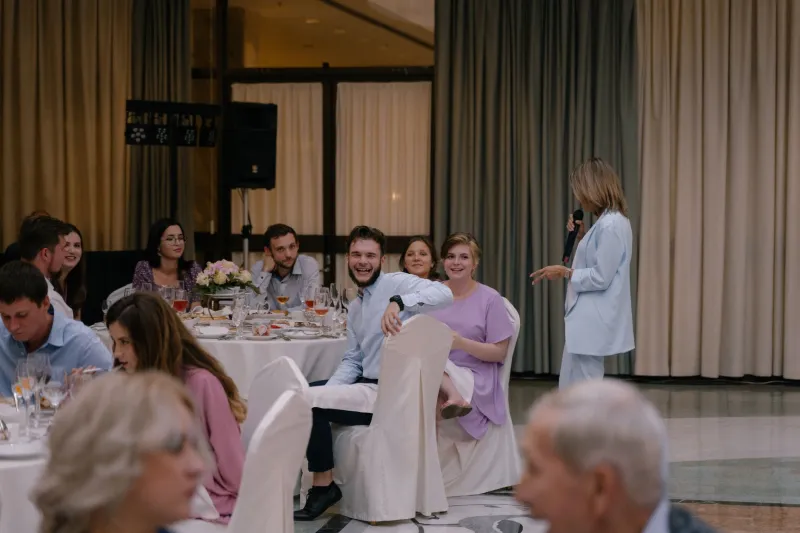
When you're standing at the top table, it can feel like all eyes are on the speaker. On film, that's only half the story. The camera is watching the bride's face during the anecdote she's heard a hundred times. It's on the groom's mum during the bit about the dog. It's catching the friend who laughs a beat late because she's already crying, and the usher who looks at his watch and then remembers to laugh.
That's the footage that makes a speech rewatchable. Not the words, exactly, but the effect of the words on the people in the room. A toast is a shared event — treat it like one and the film will feel like the day did, rather than like a recording of a man at a lectern.
The best bits happen off-mic
There's a reason we don't just lock off a camera on the speaker and leave it. The laughter rolling around a marquee, the glance between two partners when a story takes a turn, the grandfather nodding along — these are what give a speech its atmosphere. They're also what most people forget to notice on the day, which is precisely why they matter on film.
So while the speech is happening, we're usually working three angles: a wide shot that shows the room, a tighter shot of the speaker, and whatever reactions we can find without becoming a nuisance. It's a balancing act. Too many cutaways and the speech feels chopped up. Too few and you lose the warmth of the room. The edit is mostly about knowing when to sit still and let a moment run.
Set the room up so the room can be seen
A lot of this comes down to things you can sort out before the day — with your venue, your seating plan and a bit of gentle forward planning.
Where the speaker stands matters. If they're tucked into a corner with a wall behind them, the shots tend to look flat and the reactions are harder to find. A speech spot with a bit of depth — space to one side, or the room wrapping around in front of them — gives us more to work with.
Top tables facing a wall are the enemy. It's a classic venue layout, but if the couple and the wedding party are staring at a blank wall, the camera has nowhere to look except the backs of heads. Where you can, angle the top table so guests are visible from it, not just decorative behind it.
Round tables are quietly brilliant for this. Long tables look lovely, but guests end up looking sideways at the speaker, which makes reactions harder to catch. Round tables mean more faces pointed in roughly the right direction. If you're choosing between the two, and reactions matter to you, that's worth knowing.
Don't put your most expressive guest behind a pillar. You know who they are. The one who cries at everything. Seat them where they can be seen.
Light is the unglamorous bit that decides everything
UK venues are beautiful and frequently dark. In November, speeches at 4pm are basically a candlelit affair whether you planned it or not. That's fine — we shoot in it — but a few things help enormously.
If the speaker is standing in front of a huge window, they'll be a silhouette. If they're lit by a phone torch, everyone looks like they're in a police interview. And if the only light in the room is behind the top table, we're working with the backs of heads again.
Ask the venue where the speeches will happen and whether the lighting can be adjusted. Festoon lights, a couple of lamps, or simply having the speaker face into the room rather than away from it can make a real difference. For winter weddings, it's worth considering speeches earlier in the day if you want any natural light on the room at all. There's no rule that says they have to happen after pudding.
Timing, and the clatter of forks
Traditionally, UK speeches sit after the meal — and that's a lovely rhythm. But it's worth thinking about what the room is doing at that point. If the venue is clearing plates while the father of the bride is midway through a story about a caravan in 1998, the audio will be full of cutlery. Ask the venue to pause service for the speeches. They're used to it. It's a two-minute conversation that saves a lot of editing.
Speeches before the meal are also worth considering, especially in winter. The room is fresh, the light is better, and everyone's still paying attention. It also means the rest of the evening can relax into itself.
And if you're planning a sunset moment, a first dance or a big group photo straight after the speeches, give it a little breathing room. The best reaction shots often happen in the thirty seconds after the last line, when the room exhales.
What we do with it all afterwards
In the edit, the speech audio stays front and centre. We're not trying to turn a toast into a montage. But we will weave in the reactions — the laugh, the glance, the hand squeeze under the table — because that's the texture of the moment. The goal is for you to watch it and remember what it felt like to be in the room, not just what was said.
One last thing: tell your speakers they'll be filmed, but ask them not to play to the camera. The best speeches are the ones delivered to the room, not to a lens. And if they land a joke, tell them to enjoy the laugh for a second before carrying on. That pause is where the good footage lives.
That's the bit that keeps the feeling alive.