Look Up, Not Down: The Unplugged Ceremony That Lets Your Film Breathe
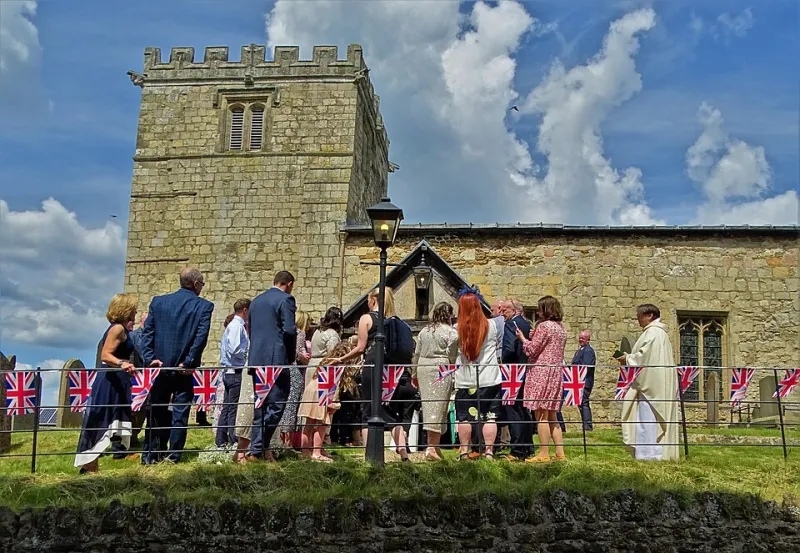
Photo: Neil Theasby , CC BY-SA 2.0, via Wikimedia Commons
Ask a room of wedding guests to do one thing differently this year and you may get a few nervous laughs. Ask them to put their phones away for twenty minutes and you would think you had suggested a digital detox in the middle of the speeches. Yet the unplugged ceremony is not a trend for tidy photographs. It is one of the simplest ways to give a wedding film the thing it cannot fake: a room full of people who are actually there.
At Ceremony, we film a lot of vows. The best footage rarely comes from a guest holding a phone above their head. It comes from the aunt who forgets to breathe during the reading, the friend who catches the groom's eye, the small ripple of laughter when the registrar mispronounces a name. Those moments happen in real time, to people who are looking up. A phone-free ceremony protects that atmosphere. It also gives your film cleaner frames, steadier sound and far fewer rectangles of light in the aisle.
The film gets quieter, and better
A mobile phone in a ceremony is not just a visual nuisance. It changes the room. Guests lean into the aisle, screens glow, notification sounds slip out, and the couple spend half the vows looking at a sea of lenses rather than faces. On camera, that reads as distraction. In the edit, we can cut around a lot, but we cannot invent the feeling of a united room.
When phones are away, the ceremony has a different rhythm. People sit stiller. They listen. They react. The film starts to sound like a ceremony rather than a camera click track. You notice the breath before the vow, the tissue being pulled from a sleeve, the celebrant's pause while everyone settles. Those tiny sounds are the texture of the day. They are also the bits couples mention when they watch the film back.
The wording that actually works
The trick is to ask early, ask warmly and make the request feel like part of the ceremony rather than a telling-off. A sign at the entrance is useful, but it works best as a gentle heads-up. Keep it human. Something like: 'We would love you to be fully here with us. Please keep phones and cameras tucked away during the ceremony. Our photographer and film crew are capturing the day, and we will share everything afterwards.' That last line matters. It answers the unspoken question: if I do not take a photo, will anyone?
For a celebrant or registrar, a short announcement before the processional does more than any sign. They might say: 'Before we begin, the couple have a small request. This is an unplugged ceremony. Please put phones on silent and keep them out of sight until after they are married. There will be plenty of time for photographs later.' It is clear, kind and takes about fifteen seconds. If you are having a church service, chat to the vicar or minister in advance. Many are happy to include a line, and some will add their own gentle humour.
Handling the anxious guest
There will always be one guest who feels lost without their phone. Usually it is not disobedience. It is habit, anxiety or a genuine worry about children, elderly relatives or the babysitter. Plan for that rather than pretending it will not happen. Ask one trusted person to be the emergency contact and let close family know they can come to them if something urgent arises. If a guest has a medical reason to keep a phone on vibrate, that is fine. The point is not to police pockets. The point is to protect the mood.
It also helps to give people a job. Ask a couple of friends to be unofficial phone minders, especially during the processional when the temptation to snap is highest. Put a basket or a small table by the entrance for anyone who wants to leave a phone behind. And make sure the message comes from you, not just the venue. A line in the order of service or on the welcome sign feels personal. A stern announcement from a stranger can feel like a rule.
What you gain
You gain faces. That is the short answer. When guests are not framing a shot, they are available to the camera as themselves. You gain sound, too: fewer notification pings, less shuffling, no one whispering 'can you see?' while the vows are being read. You gain a ceremony that belongs to the people in the room rather than the people watching through a screen.
And you gain a film that feels less like an event being documented and more like a moment being lived. That is not anti-phone. It is pro-presence. For twenty minutes, the room agrees to be in one place at one time. The photographs will still happen. The group shots will still be taken. The reception can be as phone-friendly as you like. But the vows get a clean run at being what they are: the bit everyone came to see.
If you are planning a 2026 wedding, consider making the ask part of your ceremony planning now. Mention it to your celebrant, print it on the sign, brief the people who will help. Then put your own phone away, too. The film will thank you for it.