The Nine-Minute Rule: what we cut from your wedding film, and what we'd never touch
Photo: Basile Morin, CC BY-SA 4.0, via Wikimedia Commons
Nine minutes is an arbitrary number. We know that. Some films want seven, some genuinely earn twelve. But as a working constraint, nine minutes does something useful: it forces every single shot to justify itself. When you have four hours of footage and nine minutes to fill, sentimentality stops being a good enough reason to keep anything.
People assume the hardest part of editing a wedding is choosing the music. It isn't. The hardest part is deleting something lovely.
What we cut, without much regret
The shoe montage. The dress hanging on the back of a door. The perfume bottle. The invitation flat-lay. These are the establishing shots of a hundred identical films, and they tell you nothing about the people getting married. Ten seconds of your dad trying to work the coffee machine while your mum shouts instructions up the stairs is worth all of them.
The full speeches. A brilliant speech is brilliant live, at a table, with a glass in your hand. On screen, twenty-five minutes of it deflates the film entirely. What survives is the line that lands, the pause before it, and the face of the person being talked about.
The second and third music track. The temptation is to score every section — getting ready, ceremony, drinks, dancing. What that actually creates is a series of adverts. One or two pieces, used sparingly, will do more than a five-part soundtrack, and silence is a legitimate choice. We'll often drop the music entirely across the vows, because the room is already making its own noise.
The wedding breakfast in real time. Nobody needs to see the room being called in.
And yes — sometimes the ceremony itself, in full. A forty-minute ceremony can give you three or four minutes of astonishing material and thirty-six of admin. We're looking for the moment the registrar says the words and one of you unexpectedly laughs. That's the shot. The rest is context.
What we keep, always
Half-heard things. A grandfather leaning over to someone at the reception and saying something that barely registered on the mic. A three-year-old announcing, mid-ceremony, that they need the loo. A speech line that got swallowed by laughter and only makes sense if you were in the room — those are the ones that will make you cry in four years' time, precisely because they weren't scripted.
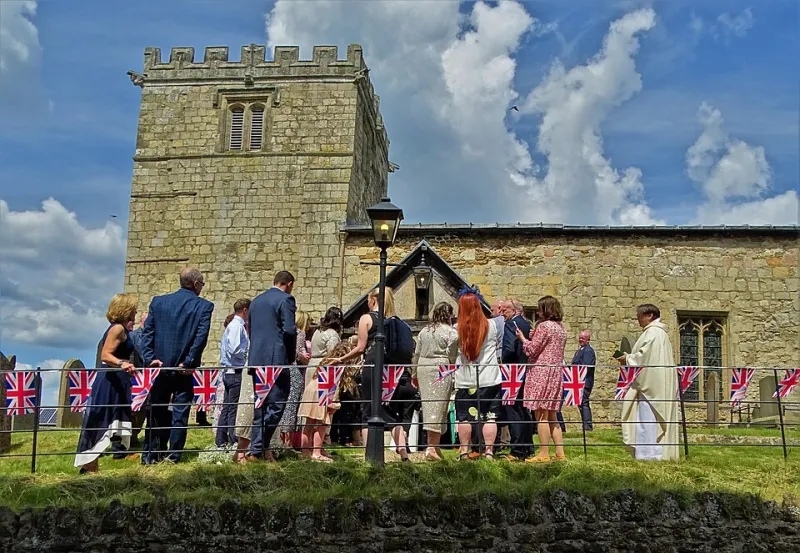
Rain. Every British couple asks whether the weather ruined it. It never did. The dash from the church to the car with a jacket over somebody's head, the marquee that leaked, the umbrellas going up in unison during the group shot — that's the day as it actually happened. A sunny wedding is a lovely wedding. A wet one is a film.
Confetti exits, but not the way you'd think. The throw itself is two seconds. We keep the twenty before it: the ushers herding people into position, someone realising they've left the confetti in the car, the couple's nervy laughter as they wait for the signal. That's the texture.
Grandparents. Not as a sentimental box-tick — because they're the least self-conscious people in any frame. They look at the couple rather than the lens. They hold hands out of habit. Keep scrolling and you'll find them in almost every frame worth having.
The service you can do us
If you want the nine minutes to keep the feeling rather than just the schedule, there are a few things worth flagging before the day — not a brief, just a nudge.
Tell us the names that matter. Not the guest list. The five or six people whose presence in the film would mean something specific. Editors work from faces, and we can't prioritise what we don't recognise.
Tell us the one reading, or the one line, that has to be in there. We'll make sure the audio is clean and the camera is on the reader rather than the crowd.
Tell us, gently, if someone important is missing. A grandparent who died in the spring, a sibling who couldn't travel. It changes the grammar of a film — a held shot on an empty chair, a pause before a toast — and it's the difference between a video of a wedding and a record of a particular family on a particular day.
And tell us your audio nightmare in advance. The best man who mumbles. The venue with the terrible echo. The band soundchecking during the speeches. We can't fix everything, but we can put a mic where it needs to be, and knowing is most of the battle.
What nine minutes is actually for
We cut to nine minutes because a wedding film isn't a document of a day. It's a reminder of a feeling. The day itself you've got — in your head, in your photos, in a hundred phone clips your friends will eventually send you. What you lose within about eighteen months is the texture of it: the nerves, the noise, the way your voice went when you said the words.
That's the job. Everything else gets cut.