When the Vows Arrive in Stereo: Filming a Two-Language Wedding Ceremony
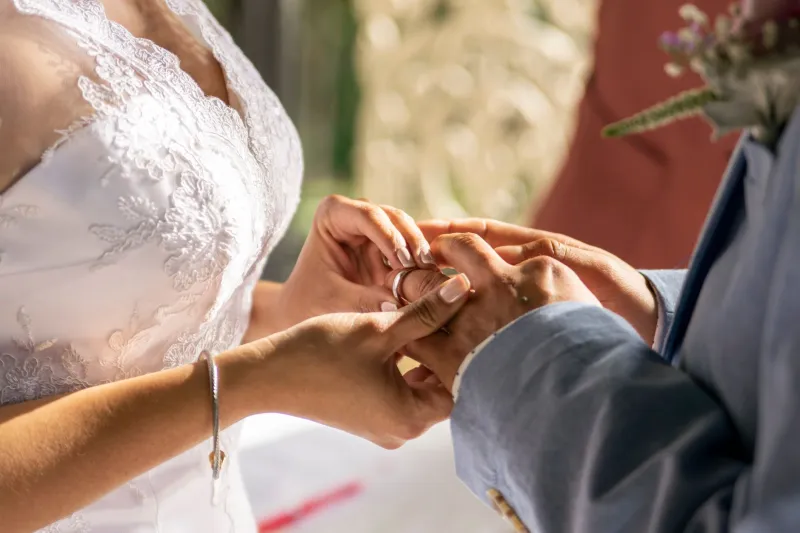
At a wedding in Manchester not long ago, the couple said their vows twice: once in English, once in Polish. The registrar's words were in English. The personal promises were in both. And the shot that stayed with me was not the couple speaking. It was the groom's nan, hands folded in her lap, hearing her grandson promise to love her granddaughter-in-law in the language she had used her whole life. She did not need a subtitle. She needed the camera to be looking at her.
That is the heart of filming a bilingual ceremony. The film should not turn into a language lesson with confetti. It should follow the feeling across both languages, so every side of the room recognises the day they were part of.
Start with the feeling, not the translation
A two-language ceremony has more than one audience in the room. Some guests will understand everything. Some will understand half. Some will understand nothing except the tone, the tears and the way a couple looks at each other when a sentence lands.
Before the day, we ask couples a simple question: which moments absolutely have to land emotionally, and in which language? It might be a reading in Gujarati, a hymn in Welsh, a vow in Irish, a speech in British Sign Language, or a line in Urdu that a parent has waited years to hear. Once we know that, we know where to point the camera and where to listen hardest.
The camera should not chase every syllable. It should chase the pause before a word, the laugh after a translation, the auntie who leans forward, the friend who whispers, 'What did she say?' and then gets it anyway from the delivery. Those reactions are not interruptions to the ceremony. They are the ceremony.
Sort the sound before the words
Bilingual weddings are a sound job before they are a picture job. If the audio is patchy, no amount of beautiful footage will rescue the second language.
We plan microphones early. That usually means a lavalier on the celebrant or registrar, lavaliers on the couple if the venue and the ceremony allow it, a handheld or stand microphone for readings, and a boundary mic or room mic to catch the congregation. If an interpreter is speaking to the whole room, they need their own microphone. If a relative is quietly translating for a grandparent in the second row, we do not try to mic that whispered version. We let it be part of the room tone.
We also ask for scripts, readings and personal vows in advance. Not to police the performance, but to learn names, pronunciation and the shape of the ceremony. We check the order of service. We note who is speaking, when the language changes, and where the laughter is likely to come from. On the day, a backup recorder runs. It is not glamorous. It is the reason the film sounds warm instead of wobbly.
In the UK, the legal ceremony often stays in English or Welsh while the second language lives in readings, personal vows, music or a blessing. That can make the day feel like two separate rooms if it is filmed carelessly. We look for the joins instead: the smile when a couple switches language, the celebrant's explanation, the guest who relaxes when they hear a familiar phrase. The film should make those joins feel natural.
Subtitles that serve the film, not the exam
Subtitles are useful. Subtitles are also a trap. If every line is translated literally, the film starts to feel like a documentary about grammar rather than a wedding film about people.
We decide early whether subtitles will be burned into the film or offered as an optional track. For a full film, an optional subtitle track can be kind to guests who want it without weighing down every frame. For a shorter highlight film, we might subtitle only the lines that carry the emotional weight: a vow, a punchline, a blessing, a name.
Translation should be checked by the couple or someone they trust. Machine translation is fine for a menu. It is not fine for a promise. We keep subtitles short, place them where they do not cover faces or hands, and time them to the breath rather than the beat. The aim is clarity, not completeness. If a line is beautiful but impossible to read in three seconds, we find a cleaner way to say it in English.
The guests who only speak one language
Monolingual guests are not a problem to be solved. They are part of the story. Watch them during a reading in another language: they listen to the rhythm, they watch the reader's face, they catch the emotion before the meaning. That is a lovely thing to film.
We look for the moment when a joke lands in two stages: first the laughter from those who understood, then the ripple of laughter from those who did not need to. We look for the parent who cries at a sentence they cannot translate because their child's voice is enough. We look for the couple glancing at each other when a word is said in the language they use at home.
In the edit, we do not explain every switch. We let context do the work. A subtitle here, a reaction there, a line of music underneath. The film can be clear without being exhaustive. Guests who speak only one language should still come away knowing what the day felt like. That is the test.
Editing two languages into one rhythm
A bilingual ceremony can tempt you into a neat pattern: English line, translated line, English line, translated line. It rarely works. It feels mechanical, and it slows the film down.
Instead, we edit for emotion. Let a line land in the original language. Then cut to the face of someone hearing it. Then bring in the subtitle if it helps. Use sound bridges so the second language carries into the next shot rather than arriving like a new scene. Keep the music low under speech. Leave room for the pause after a vow, because that pause sounds the same in any language.
We also ask couples whether they want one film or two versions: a full film with subtitles and a shorter cut for sharing. A social edit might need more translation, or less. It depends on who is watching and where. The main film should still feel like one wedding, not two ceremonies stapled together.
What we ask before the day
We ask for a list of languages, speakers and pronunciations. We ask which lines are private and which are for the room. We ask whether subtitles should be burned in or optional. We ask who can check the translations. We ask about family sensitivities, surprises and the one phrase that would mean everything to a grandparent.
Then we put the cameras down and listen. A bilingual ceremony is not a technical challenge with a couple attached. It is a day where love arrives in more than one language, and the film's job is to keep every version of that feeling alive.
At Ceremony, that is always the goal: not to translate the day, but to make sure nobody watching it later feels left out of the room.