The Flower Girl Has Notes: Filming Children at a Wedding Without the Cutesy Overload
Photo: Dancilia, CC BY-SA 4.0, via Wikimedia Commons
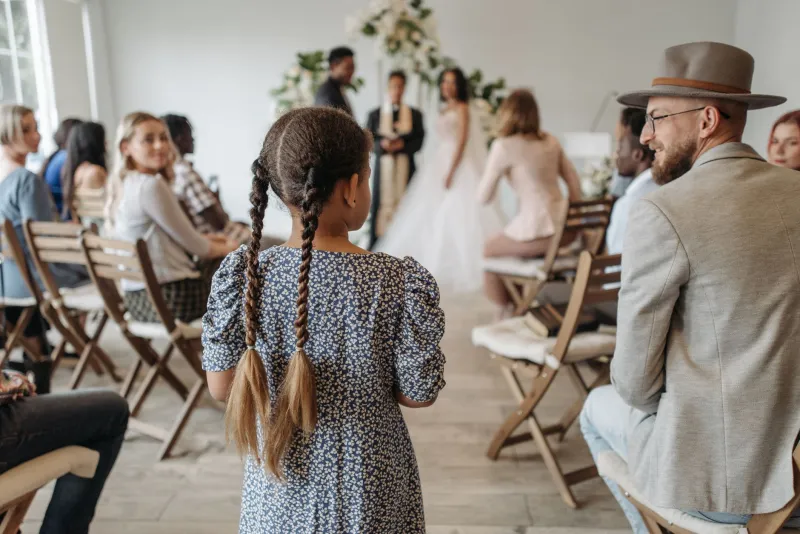
Children at a UK wedding are not a side dish. They are often the only people in the room saying exactly what everyone else is thinking. The flower girl who announces that the aisle is “very long”, the page boy negotiating hard at the sweet table, the toddler who has chosen a quiet corner under a chair as the best seat in the house — these are not interruptions to the real story. They are part of it.
The trouble starts when a wedding film treats children as a cute side-order. Cue the jaunty ukulele, the slow-motion confetti grab, the montage of small shoes and giggling faces. It looks sweet for about ten seconds, then it starts to feel like a completely different wedding from the one everyone actually attended. At Ceremony, we would rather film children the way we film everyone else: with curiosity, a bit of patience and a healthy respect for the fact that they are not there to perform.
They are not a side plot
A wedding day has a schedule. Children do not. That is precisely why they are useful on camera. While the adults are trying to keep to the timings, a child is usually busy noticing something better: the echo in the church, the wobble of a chair, the fact that nobody has yet given them any cake. Those small observations tell you what the day felt like, not just what it looked like.
A good wedding film needs those textures. It needs the bit where the bride’s niece asks, quite loudly, whether it is nearly food time. It needs the page boy who has taken his bow tie off and is wearing it as a wristband. It needs the baby asleep through the speeches while the whole room is laughing. None of that needs arranging. It just needs someone to be paying attention.
The best bits are usually heard before they are seen
Children are audio gold. They do not know how to edit themselves, which is why the things they say land so well on film. A wireless mic placed near the top table or a discreet ambient recorder in the room will often pick up more than any camera pointed directly at them. You might catch a whispered “you look nice” from a small bridesmaid, or a very serious explanation of why the dog is not allowed at the party.
That is why we try not to chase children with a lens. The moment they notice the camera, the moment changes. Instead, we stay back, keep the shot wide enough to include the context and let the sound do the heavy lifting. If a child says something funny, we do not need to swing the camera round and make it obvious. The line will still be there in the edit, sitting under a shot of the grown-ups laughing.
Consent starts with the grown-ups, then the child
Filming children properly means asking first. Before the day, we ask couples to flag any children who will be present and to check with parents or guardians that they are happy for them to appear in the film. On the day, a quick word with Mum or Dad is usually enough. It is not a legal box-ticking exercise; it is just good manners.
If a child says no, turns away or puts a hand up, that is a no. We do not bribe, coax or promise sweets in exchange for a wave. We also do not film in toilets, changing areas or any private moment where a child is being cleaned up or comforted. And if a parent later decides they would rather their child was not in the final film, that is fine. The story can be told without them.
Do not turn them into a performance
The worst thing you can do to a child on a wedding day is give them a job for the camera. “Just wave at us,” “do that again,” “look really happy” — it all drains the realness out of the moment. A flower girl walking down the aisle is not a model in a shoot. She is a small person doing something slightly terrifying in front of a lot of people. The film should respect that.
That does not mean every child moment has to be serene. A mid-meltdown can be part of the story, but it needs handling with care. We would rather catch the aftermath — a parent crouching down, a hand on a shoulder, a biscuit being produced from a bag — than linger on the tears for comic effect. The same goes for the sweet table. It is a documentary goldmine, but it is not a joke. Film the negotiations, the handfuls, the serious business of choosing between two biscuits. Then cut away before it becomes a stunt.
The quiet ones matter too
Not every child is a performer. Some are shy, some are tired and some would rather spend the reception under a table with a colouring book. Those children are just as valuable on film. A toddler asleep under a chair while the band plays is a lovely, honest image of a long day. A small boy holding his dad’s hand at the edge of the dance floor says more about family than any choreographed group shot.
We look for stillness as much as chaos. A child watching the first dance from the side, eyes wide. A little girl carefully rearranging the hem of her dress. A page boy sitting on the steps outside the village hall, shoes off, entirely done with the whole business. In the edit, those moments often do more work than a dozen slow-motion giggles.
One real line beats a whole montage
In the edit, restraint is everything. We might use two or three child-led moments across a film, not a whole section of them. We keep the actual audio wherever possible, because a child’s voice is far more affecting than a jaunty track laid over the top. We avoid the obvious clichés: no xylophones, no speeded-up footage, no “aren’t kids funny” voiceover.
The best compliment a couple can give us is that the film feels like their day. That includes the children. It includes the flower girl who had notes, the page boy who raided the sweet table and the toddler who slept through the speeches. They were not a side plot. They were guests, witnesses and occasionally the best narrators in the room. Film them like that, and the feeling stays alive long after the cake is cut.