The View From the Front Row: Why Wedding Films Should Stay at Eye Level
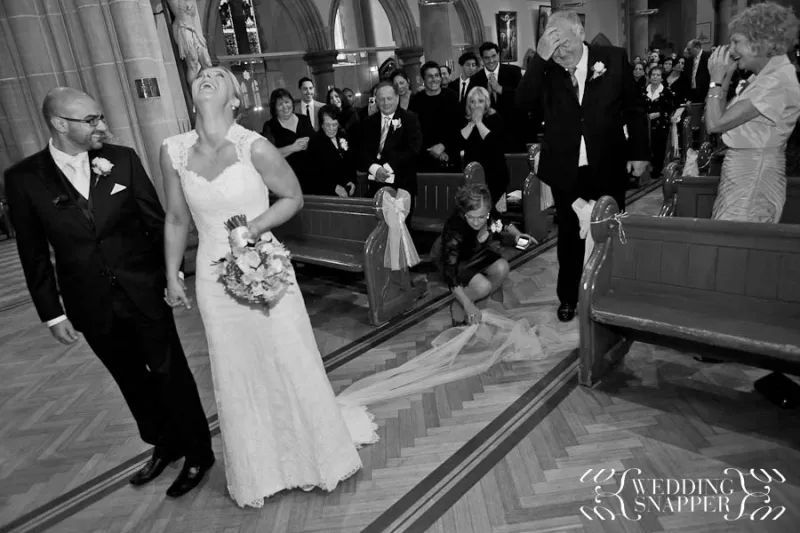
Photo: Simon Woodcock / Wedding Snapper Photography, CC BY-SA 3.0, via Wikimedia Commons
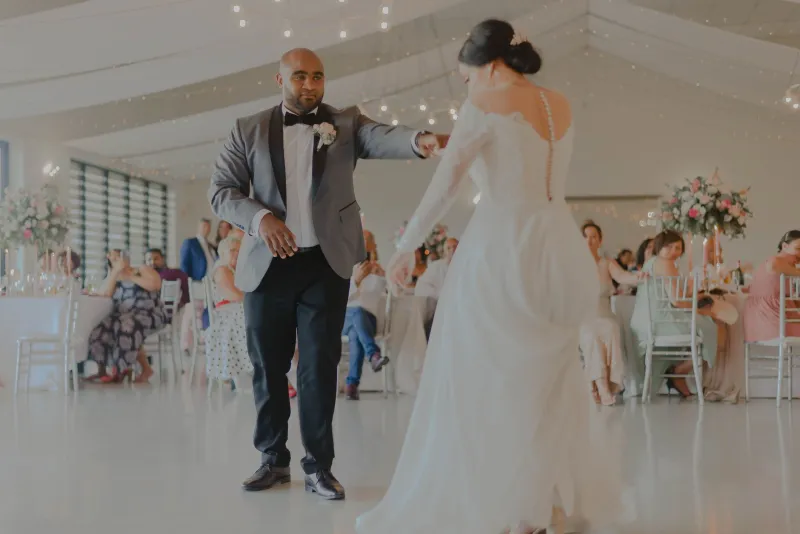
Ask a couple what they remember from their wedding film a year later and almost nobody mentions the bit where the camera went up 120 metres. They mention Dad's face during the speech. The way Nan grabbed the groom's arm as they came back down the aisle. The sound of a chair scraping on the floor just before the registrar said the words. Those are ground-level memories, and they are the ones that keep a film alive.
Aerial footage has its place. It can be genuinely lovely. But somewhere along the way, the drone shot became the default proof that a wedding film is 'properly' made — as if a sweeping view of a marquee from above says more about a marriage than the two seconds where the bride's hand tightens on her dad's sleeve. It usually doesn't. Most of the time, it just says the filmmaker owns a drone.
The shot that looks expensive and feels cheap
There is a particular kind of wedding film that opens with a slow aerial push over a country house, cuts to a drone reveal of the ceremony lawn, then swoops over the canapés like a seagull eyeing a sausage roll. It looks polished. It also feels weirdly empty. You could swap the couple for any other couple and the shot would still work. That is not a compliment.
A drone shot is context. It tells you where you are. It does not tell you what it felt like to be there. For that, you need a camera at human height, close enough to catch the half-second before someone laughs or the way a groom's shoulders drop when he finally exhales. Those moments do not happen 400 feet in the air. They happen at eye level, in the front row, near the back of the room, and by the tea urn.
What actually survives the first watch
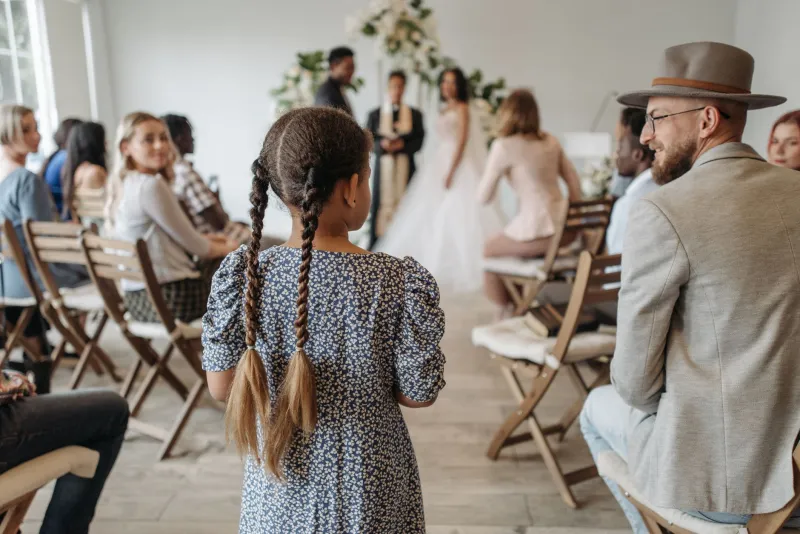
When we edit a wedding film, the clips that earn their place are rarely the most technically ambitious. They are the ones with a pulse. A mother adjusting a veil with slightly shaky hands. A best mate muttering 'you've got this' through a crack in the door. A flower girl abandoning her posy to inspect a stone floor. The celebrant's pause before the vows. The collective shuffle as everyone stands.
None of that is cinematic in the postcard sense. It is better than that. It is specific. It makes the film feel like a day that happened to real people rather than a brochure for a venue. And specificity is what makes a wedding film rewatchable — not because the sky looked nice, but because the people in it look like themselves.
When a drone genuinely earns its keep
This is not an argument for banning drones from every wedding. There are days when an aerial shot does real work. A rural venue with a long lane and a church you can only understand from above. A coastal wedding where the sea is part of the story. A farm in Yorkshire, a cliff in Cornwall, a castle in Scotland — places where the landscape is genuinely part of the day and a ground-level camera cannot show the scale of it.
Even then, the aerial should be a sentence, not the whole paragraph. Thirty seconds of establishing footage can set the scene beautifully. Three minutes of it starts to feel like you are watching a property listing. The question is not 'can we fly here?' but 'does this shot tell us something the ground cannot?' If the answer is no, put the drone away and pick up the camera that can see a face.
How to brief your filmmaker without micromanaging
You do not need to hand your filmmaker a shot list with 'no drones' written in red pen. You do need to tell them what you value. A good brief sounds less like a technical spec and more like a set of priorities: 'We care more about the reactions than the venue'; 'Please don't fly during the ceremony — we don't want the noise'; 'We love the bit where everyone is just milling about after the vows, so please don't rush off to get the sunset shot.'
Ask three practical questions before you book anyone. First: how much of the finished film will be aerial footage? If the answer is vague, ask to see a full film rather than a highlight reel. Second: will the drone be flown over the ceremony or the guests? In the UK, drone operators need a Flyer ID and Operator ID, and they should not be flying over crowds. A reputable filmmaker will have insurance and a clear plan. Third: what happens if it rains or the wind picks up? The answer should not be 'we'll just use it anyway'.
The UK venues that make the point for us
A drone shot of a village hall in the rain is not automatically romantic. A drone shot of a registry office in central London is mostly roof tiles and a bus lane. Some of the best wedding films we have seen were shot entirely at ground level in places with no view at all — a side room with strip lights, a pub function room with a carpet that has seen things, a marquee in a field with the sides flapping. Those films work because the camera stayed close to the people, not because it escaped them.
The British weather helps here, oddly. If it is drizzling, nobody wants the camera to disappear for twenty minutes to get a flyover. They want it in the room when the umbrellas go up and the laughter starts. The best ground-level films are made in the thick of it, not above it.
The test of a good wedding film
Watch your film with the sound off. If it still makes sense — if you can still tell who loves who, who is nervous, who is about to cry — then the camera was in the right place. If it only works because of a sweeping aerial and a swelling piano track, it might be a nice video. It is not yet a wedding film.
The view from the front row is not as dramatic as the view from the sky. It is just more likely to make you feel something in ten years' time. And that, really, is the whole point.